
From the clipboard to the camera: the origin story of the Sapphire family
- GemOne Talks
Most product managers inherit a roadmap somebody else started. Hoa Cha didn’t. GemOne’s own history begins further back than most people realize, in Australia, where the business first operated as Global Equipment Monitoring, long before the name GemOne existed anywhere. Hoa, an Australian himself, has been attached to the Sapphire line since that very first version, which makes him less a product manager in the ordinary sense and more the one person who can actually explain why every feature on the product today exists at all, because he was in the room for most of the decisions that put it there.


Before we get into what Sapphire actually does today, what does a job like product manager for a piece of industrial hardware even involve, day to day?
“If you look at the whole product as a whole, you have your hardware, you have your firmware, but also the data,” he says. Three things that rarely agree with each other, in his experience. The hardware has to survive a warehouse floor for years. The firmware has to keep behaving correctly long after the engineer who wrote it has moved on to something else. And the data has to actually mean something once it lands in front of a customer who isn’t going to read a manual to find out. Miss any one of the three, and the other two stop mattering as much, no matter how good they are on their own.
You’ve been with Sapphire since its very first version.
What did that original version actually look like, compared to today?
The earliest version had almost nothing in common with what ships today. It was little more than a digital checklist, he explains, a way of replacing a paper form on a clipboard with something that could actually be tracked and tied to a specific operator. Everything since, the cameras, the certification tracking, the reporting layer, got layered on afterward, one generation at a time, in direct response to what customers were actually running into on the floor rather than what looked good on a roadmap slide.

Given how much has changed since then, what’s a product decision you’d defend to anybody, even years later?
“The product decision I would defend to anybody would be keeping our products user-friendly,” he says. “If our product can’t be sold to scale, then it’s not a very good product.” From the operator actually running through a safety checklist to the person reviewing the report, simple and intuitive is what gets the job done correctly every time.
The V2SC still stands out to Hoa as one of the clearest examples of that principle in action. “Yeah, the V2SC was actually one of my babies,” he says, still visibly proud of it, years later, and rightfully so.
What does it actually take to keep Sapphire delivering value, year after year?
“People assume it’s mostly about the next big feature. In reality, most of the real work is actually about reinforcing the fundamentals to ensure the Sapphire product line continues to add value while the requirements continuously grow. Whether it’s ensuring a high uptime or backwards compatibility with legacy products, the goal is to continuously improve.”
When Sapphire ships an update, does that reach the units already out in the field, or only new hardware going out the door?
Well, updates can be seen at two levels; the firmware and also the software, GemOne Cloud. Software updates are always pushed and are available to every device within the portal. Firmware updates are also pushed to devices rather than waiting for the next generation of hardware to arrive. It’s the same instinct at work again: a customer shouldn’t have to buy new hardware just to get something the team learned two years into shipping the last one.
With customers running different hardware generations side by side over the years, how do you keep all of that data making sense in one place?
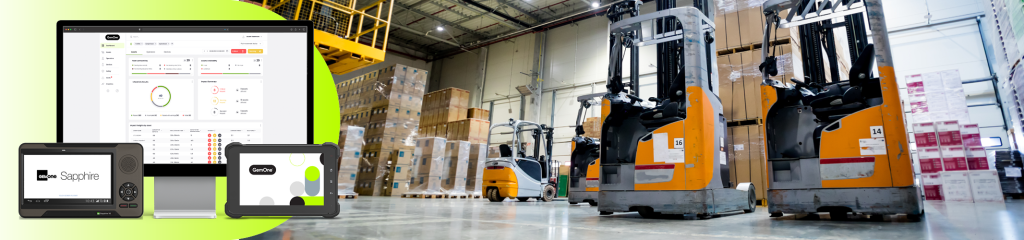
“That’s the beauty of GemOne Cloud as well,” he says. “We have backwards compatibility between the V2SC and even older models like the V2, all on one single platform.” Nobody should have to manage two separate systems just because their fleet was built up over several years instead of bought all at once.
Last question: what’s the biggest misconception people have about what it actually takes to keep a hardware product like Sapphire running for over a decade?
“People assume it’s mostly about the next big feature. In reality, most of the real work is actually about reinforcing the fundamentals to ensure the Sapphire product line continues to add value while the requirements continuously grow. Whether it’s ensuring a high uptime or backwards compatibility with legacy products, the goal is to continuously improve.”
About the author
Manager Productization
Hoa Cha is the Productization Manager at GemOne. He doesn’t fit the typical mold of a product manager who inherits someone else’s roadmap. His history with GemOne stretches back to its origins in Australia, when the company operated as Global Equipment Monitoring, and he has been anchored to the Sapphire product line since its very first iteration.

